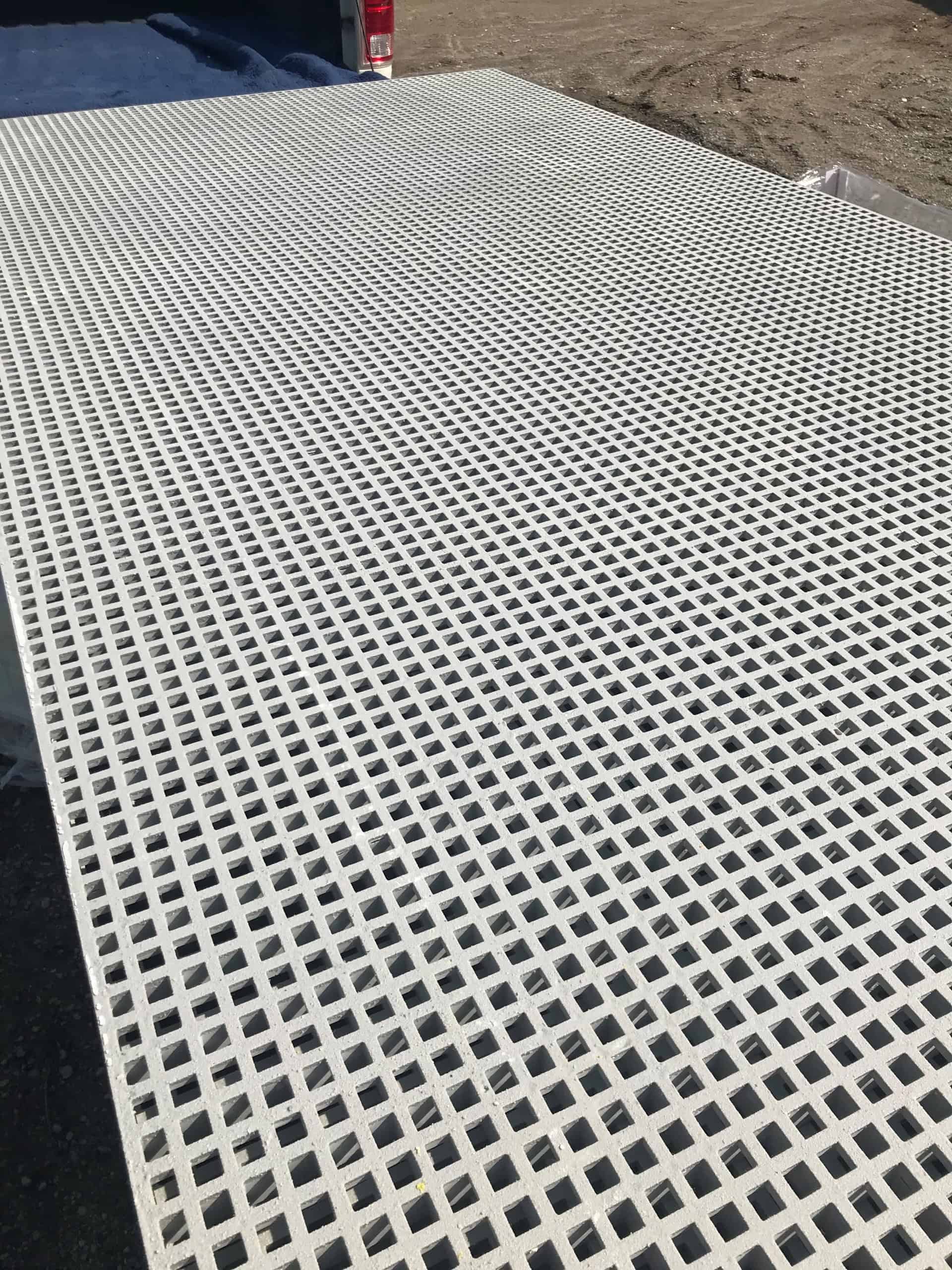
If you are pricing walkway panels, platform decking, or a corrosive plant upgrade, molded fibreglass grating is usually a fast option. It is lighter than steel, easier to handle, and built for wet, chemical, and high-traffic areas. But buyers still ask the same thing: what matters most before ordering? National Grating positions molded FRP grating as a strong, corrosion-resistant, lightweight option with fast quotes, broad stock, and service across Canada and the U.S.
What exactly is molded fibreglass grating?
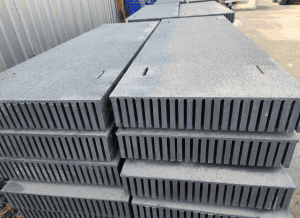
It is a one-piece FRP grating panel made from glass reinforcement and resin, built for corrosion resistance, slip resistance, and long service life in industrial settings.
Molded fibreglass grating, also called FRP grating or fibreglass grating, is formed as a panel rather than assembled bar by bar. That matters because it gives the panel bi-directional strength and makes it useful for walkways, trenches, docks, mezzanines, and access platforms. It is often chosen where steel rusts, coatings fail, or electrical conductivity is a concern. Suppliers also offer different resin systems, including vinyl ester fibreglass grating and fire-retardant fibreglass grating, depending on the environment.
Why do so many plants choose FRP grating instead of steel?
FRP grating resists corrosion, needs less maintenance, and is easier to install in wet or chemical-heavy areas than steel grating.
The main comparison is still FRP vs. steel grating. Steel can be a good fit for some heavy structural work. Still, in wastewater plants, food processing facilities, chemical-handling facilities, and marine sites, molded fibreglass grating solves common steel problems. It does not rust like bare steel. It can be made with anti-slip surfaces. It is also non-conductive, which helps in electrical areas. National Grating and other suppliers highlight the same core value: long life, safety, and lower upkeep. That is why searches for FRP grating vs. steel grating and corrosion-resistant grating remain popular.
Where does molded fibreglass grating work best?
It works best in places with water, chemicals, salt, slip risk, or constant washdown, where metal grating tends to wear out faster. This product is common in industrial flooring, catwalks, cooling towers, pump pads, rooftop access, marine docks, and processing plants. It is also a solid choice for dock grating, fibreglass decking, and industrial fibreglass floor grating where traction matters.
If you need anti-slip, chemical-resistant, or heavy-duty fibreglass grating, the application usually drives the resin, panel depth, and surface choice. Mini-mesh options are also used where smaller openings improve heel safety or reduce the risk of dropped tools.
How do you choose the right panel size and type?
Start with span, load, environment, and surface finish, then match those needs to panel size, resin system, and mesh style.
This is where it helps to look past the standard panel size. National Grating carries common sizes like 4′ x 12′ molded fibreglass grating, but choosing the right panel is really about the job itself. You need to know the span, the weight it needs to carry, the support layout, the site conditions, and whether a smooth meniscus or grit-top surface makes more sense. National Grating also points buyers to its grating selection chart and molded grating load tables so they can match the product to the application. That is why load tables, span details, and grating size options matter more than picking based on price alone.
Talk to National Grating about panel size, resin, surface, and load requirements so you get the right grating the first time.
Is molded fibreglass grating the same as pultruded grating?
No. Molded grating is made as a one-piece panel with bi-directional strength. Pultruded grating is built from bearing bars and is usually suited to longer spans and certain directional load conditions.
Yes. One reason FRP grating is popular is that it is easier to fabricate and trim than steel, provided the right tools and sealing methods are used.
Yes. It is often used for dock grating and waterfront access because it handles moisture and corrosive exposure better than unprotected steel.
No. Surface type matters. Meniscus and grit-top finishes offer different traction levels, so the right choice depends on your site and cleaning conditions.
https://nationalgrating.com/wp-content/uploads/2026/10/Molded-Fibreglass-Grating-FAQs-Bridge.png9411672Ballantine Digitalhttps://nationalgrating.com/wp-content/uploads/2022/01/NG-Logo-JAN-2022-300x128.pngBallantine Digital2026-09-20 18:21:482026-11-13 14:44:28What Should You Know About Molded Fibreglass Grating Before You Buy
Choosingpultruded FRP grating is not only about selecting the right panel size or thickness. The grating also has to perform across the required span while supporting the loads expected in the application.
That is where a pultruded FRP grating load table becomes important. Load tables provide information about deflection and load capacity at different spans, helping contractors, engineers, facility managers, and other buyers compare grating options for a project.
National Grating provides pultruded fiberglass grating in several bearing bar profiles and sizes for industrial, commercial, marine, transportation, water treatment, and other applications. Understanding the load table can help you narrow down the options before placing an order.
Key Takeaways
Pultruded FRP grating load tables help compare grating styles based on span, load, and deflection.
The bearing bars run in the span direction and are responsible for carrying the load.
National Grating offers I-Shape, T-Shape, and High-Load bar profiles for different applications.
Longer unsupported spans generally result in greater deflection under the same load.
Concentrated and uniform loads affect grating differently, so the correct table needs to be used.
Proper support and installation are important for achieving the intended performance of the grating.
Understanding a Pultruded FRP Grating Load Table
A pultruded FRP grating load table shows how a particular grating style performs at different spans and loads. National Grating’s brochure includes separate tables for concentrated line loads and uniform loads, with deflection values listed for multiple grating styles and span lengths.
Deflection refers to how much the grating bends under a specified load. The tables also provide maximum recommended loads and ultimate capacities for the listed configurations. These numbers make it possible to compare products rather than selecting grating based on thickness alone.
The distinction between recommended load and ultimate capacity is important. Ultimate capacity should not be treated as the normal working load for a project. The appropriate grating should be selected according to the project’s design requirements, applicable safety factors, support conditions, and expected loads.
The span direction matters because pultruded grating is designed differently frommolded fiberglass grating. With pultruded FRP grating, the bearing bars carry the load and must run in the direction of the span.
National Grating explains that the length of a pultruded grating panel is the bearing bar direction. The width consists of the cross rods and is not intended to carry the primary load. This makes it important to know how the panel will sit on its supports before determining the required dimensions or ordering material.
A panel may physically fit an opening when turned in either direction, but that does not mean both orientations provide the same structural performance. The bearing bars need to span between the supports as intended.
Pultruded Grating Bearing Bar Profiles
National Grating’s pultruded grating is available with I-Shape, T-Shape, and High-Load bar profiles. Each category provides options for different applications and load requirements.
I-Shape bars provide a high strength-to-weight ratio and are available in several profiles. T-Shape bars provide greater surface area and are commonly used for pedestrian applications such as walkways, stairs, decks, pool areas, and similar surfaces. High-Load bars are intended for heavy-duty applications where greater load capacity may be required.
These profiles are available in different depths and open-area configurations. Rather than assuming one profile is appropriate for every project, the load requirements, span, traffic, environment, and support layout should all be considered.
If you are comparingpultruded fiberglass grating for an upcoming project, National Grating can help you review the available profiles and determine which options match your specifications.
How Span Affects FRP Grating Deflection
As the unsupported span increases, grating generally deflects more under the same load. This relationship can be seen throughout the concentrated and uniform load tables in National Grating’s brochure.
For that reason, the distance between supports is an important part of product selection. A grating configuration that performs well across a shorter span may not provide the same performance when the supports are farther apart.
The brochure includes data for spans ranging from 12 inches through 72 inches, depending on the grating style and load condition. Rather than selecting a panel first and adjusting the supports later, it is useful to consider the grating and support layout together.
Concentrated Loads vs. Uniform Loads
A concentrated load places force on a limited area or line of the grating, while a uniform load distributes force across a larger portion of the surface. Because those loads act differently, National Grating provides separate performance tables for each condition.
The concentrated line load table shows deflection under different loads at various spans. The uniform load table provides deflection information for distributed loads and lists maximum recommended loads and ultimate capacities in pounds per square foot.
Knowing which type of load best represents the application is necessary when reviewing the tables. A walkway supporting pedestrian traffic, for example, does not necessarily place the same type of demand on the grating as equipment or another concentrated load.
Proper Support for FRP Floor Grating
Even properly selectedfiberglass grating depends on adequate support. National Grating recommends reading the applicable load tables to determine support spacing and making sure the floor grates receive.
https://nationalgrating.com/wp-content/uploads/2026/10/Blog-Image.png6301024Ballantine Digitalhttps://nationalgrating.com/wp-content/uploads/2022/01/NG-Logo-JAN-2022-300x128.pngBallantine Digital2026-09-15 11:59:582026-10-16 17:44:22How Do You Read a Pultruded FRP Grating Load Table?
If you have ever tried to source FRP grating fast, you already know the problem. One supplier has a price but no stock. Another has stock but slow replies. A third gives you a quote, then leaves you waiting on lead times. That is why National Grating stands out.
We focus on the things buyers actually care about: deep inventory, helpful service, high-quality products, and pricing that makes sense for the job. We stock fibreglass grating, beams, angles, and specialty products at distribution centers across North America, with fast quotes and quick shipping.
What makes National Grating different from a typical FRP supplier?
We combine broad stock, strong service, and practical pricing to solve the biggest problems buyers face when ordering FRP grating.
Many suppliers sell FRP grating. Fewer make the process easy. National Grating is a go-to source for fibreglass grating, molded and pultruded products, and structural FRP across Canada and the U.S. We offer fast quotes, stocked material, and support from people who know the product line, which matters when you are buying for a plant, dock, platform, or access system.
Why does big inventory matter so much when buying fibreglass grating?
Because stock on hand can cut delays, keep jobs moving, and give buyers more choices in panel size, resin, and product type.
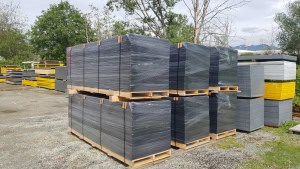
National Grating stocks a wide range of products, including molded grating, pultruded grating, stair treads, FRP plate, beams, angle, and tubing. Most sizes are in stock and can ship quickly. For buyers, that means less waiting and fewer project headaches. If you need fibreglass grating panels, 4’x8 fibreglass grating, mini-mesh fibreglass grating, or heavy-duty fibreglass grating, access to real inventory matters just as much as price. We have one of the biggest inventories in North America.
How does customer service change the buying experience?
Good service helps buyers choose the right product faster, avoid mistakes, and get answers before a job goes off track.
National Grating has knowledgeable sales staff, project coordinators, and technical support for customers across North America, and we are always available to answer the phone when customers need guidance. We provide exceptional service and aim to find the most cost-effective solution for each application. That matters because FRP projects are rarely one-size-fits-all. Buyers may need help comparing FRP vs. steel grating, choosing between molded and pultruded options, or deciding whether fire-retardant fibreglass grating or vinyl ester fibreglass grating makes more sense for the site.
What kinds of products can buyers get from National Grating?
We are more than just grating. We also supply structural FRP products for full-access and support systems.
National Grating does not stop at floor grating. We also stock molded fibreglass grating, pultruded fibreglass grating, stair treads, FRP plates, beams, angles, and tubing. That makes it useful for buyers building larger systems such as fibreglass catwalk systems, FRP platform systems, prefabricated FRP platforms, fibreglass mezzanine framing, and FRP equipment support frames. If you are also comparing fibreglass square tube, FRP tubing, or pultruded fibreglass structural shapes, working with a single supplier can simplify the entire order.
Who is National Grating a good fit for?
We are a strong fit for buyers who need FRP products quickly, want real support, and care about long-term value, not just a low quote number.
Some buyers come in looking for a simple panel. Others need a broader package with grating, railing, and structural shapes. National Grating serves both. Our network of distribution centers in North America, stocked products, and custom cutting capability make it useful for maintenance teams, contractors, engineers, and plant buyers alike. Whether the need is corrosion-resistant grating, molded fibreglass grating supplier support, or a source for FRP structural shapes, the company is set up to handle more than a basic order.
When buyers say they want the largest inventory in NA, excellent customer service, and the best value for the price, they are really saying they want fewer problems. That is the real value National Grating is selling. If you are sourcing fiberglass grating, comparing FRP options, or planning a new platform or walkway, reach out to National Grating for a quote and product guidance tailored to your job, timeline, and budget.
FAQs
No. We also supply pultruded grating, stair treads, FRP plates, beams, angles, channels, and tubing.
Yes. We offer custom cutting and fabrication for FRP solutions to help customers complete projects more efficiently.
Yes. National Grating states serves customers across Canada and the United States, with locations and distribution support in both markets.
Yes. Our product range includes structural FRP items such as beams, angles, and tubing for broader framing and support applications.
https://nationalgrating.com/wp-content/uploads/2026/09/choose-national-grating.png10241536Ballantine Digitalhttps://nationalgrating.com/wp-content/uploads/2022/01/NG-Logo-JAN-2022-300x128.pngBallantine Digital2026-09-08 14:50:402026-10-16 17:44:38Why Do So Many Buyers Choose National Grating Over Other FRP Grating Suppliers?
FRP grating is not only for floors, platforms, and walkways. It can also be used vertically in fencing, guarding, screening, and enclosure applications where metal is not always the best fit.
For many industrial sites, fencing has to do more than mark a boundary. It may need to protect electrical equipment, separate workers from restricted areas, provide visibility, withstand weather conditions, and reduce maintenance needs. That is where FRP non-conductive fencing can be a smart option. Made from fibreglass reinforced plastic, FRP fencing offers strength, corrosion resistance, and electrical non-conductivity without the weight and rust issues that often come with steel.
National Grating is already known for FRP grating, molded fibreglass grating, pultruded FRP grating, stair treads, FRP plate, and structural FRP products for industrial and commercial applications. Those same FRP qualities can also make sense in vertical applications, especially around electrical, utility, wastewater, marine, chemical, and industrial sites where safety and long-term durability matter.
Why Use FRP Grating for Non-Conductive Fencing?
FRP grating can be a practical choice for fencing because it is tough, lightweight, open, corrosion-resistant, and non-conductive. It creates a clear barrier while still allowing air, water, light, and visibility to pass through.
Steel and aluminum fencing can work well in many settings. The problem is that some sites are harder on metal than others. Near electrical equipment, substations, rooftop units, control panels, and washdown areas, as well as in industrial environments, metal surfaces may require more maintenance, greater protection, and more careful planning because they can conduct electricity and rust over time.
FRP grating gives project teams another option. The open-grid design can be used as a vertical screen or fence panel, while the fibreglass-reinforced plastic construction helps reduce concerns related to conductivity and corrosion. FRP products are commonly valued for qualities such as corrosion resistance, lightweight, long life, safety, and electrical non-conductivity.
Where Does Non-Conductive FRP Fencing Make the Most Sense?
FRP non-conductive fencing is a good fit for areas where electrical safety, corrosion resistance, airflow, and low maintenance are important. It is often considered for utilities, plants, rooftops, marine facilities, and restricted industrial zones.
One common use of FRP fencing is around electrical equipment. This can include transformer areas, switchgear, battery storage systems, communication equipment, solar sites, and utility enclosures. In areas like these, it can help to limit the amount of conductive material near sensitive or energized equipment.
FRP fencing can also work around wastewater treatment plants, pump stations, chemical storage areas, processing facilities, docks, piers, and cooling towers. These are places where steel fencing may be exposed to moisture, chemicals, salt, spray, or constant exposure to the elements. Over time, rust can weaken metal and make the area look neglected. FRP helps avoid many of those corrosion issues.
FRP can also work well for rooftop equipment screens. Many rooftops have HVAC units, mechanical systems, cooling equipment, and safety areas that need to be separated or kept out of view. Since FRP panels are lighter than many metal options, they can be a good fit for projects where weight is a concern.
How Does FRP Fencing Improve Electrical Safety?
FRP is non-conductive, so it does not carry electrical current the way metal can. That makes it useful in fencing applications near electrical systems, energized areas, utilities, and equipment yards.
FRP fencing does not replace proper electrical design, lockout procedures, grounding plans, or code requirements. Those still matter. The difference is that FRP is not metal, so the fence itself does not create the same conductive path in some projects, which can be an important detail.
Non-conductive fencing can be especially valuable where workers, contractors, or maintenance crews may be near equipment during inspections or service. A fence or screen may be touched often, leaned against, opened, washed down, or worked around with tools. Using FRP in those locations can help reduce one more possible risk.
FRP is also useful where metal structures may interfere with signals. Fibreglass structures and pultruded fibreglass grating can be “electronically transparent” and do not interfere with radio frequency transmissions the way steel structures can. This can matter around communication sites, antenna areas, utility monitoring systems, and certain industrial controls.
Why Is FRP Fencing a Good Choice for Corrosive Sites?
FRP fencing is a strong option for corrosive sites because it does not rust like steel. It can handle wet, salty, chemical, and industrial environments with less maintenance.
Corrosion does more than make fencing look old or worn. Rust can stain nearby surfaces, weaken panels, damage hardware, create sharp edges, and lead to more repairs. In wastewater plants, marine docks, refineries, food-processing facilities, chemical plants, and car washes, metal fencing is often exposed to moisture, chemicals, salt, and frequent washdowns that can break it down over time.
FRP grating is often used in demanding environments for this reason, such as walkways, platforms, trench drain covering, stair treads, marine docks, car washes, and other industrial uses where corrosion resistance and safety are important.
When FRP grating is used vertically as fencing or screening, those same benefits still apply. Rain, splash, chemicals, humidity, and salt air are less likely to create the same repair cycle that often comes with painted or galvanized metal.
What Makes FRP Fencing Easier to Handle and Install?
FRP fencing panels are lighter than many steel panels, so they are easier for crews to move, cut, lift, and install. That can make a real difference on tight job sites where space is limited or access is not simple.
Weight matters more than it may seem. A fence panel might need to be carried up stairs, brought across a roof, worked into a narrow area, or installed around equipment that is already in place. Using a lighter material can make the job easier and less awkward from start to finish.
FRP grating can also be fabricated to fit the job. National Grating offers full FRP grating panels and cut-to-size options, which can help customers receive material that is closer to installation-ready.
For vertical applications, project teams may use FRP grating panels with FRP structural shapes, posts, channels, angles, or framing, depending on the design. This can create a more complete FRP barrier system rather than mixing too many materials in a single corrosive or electrically sensitive area.
Can FRP Fencing Provide Visibility and Airflow?
Yes. The open grid pattern of FRP grating allows visibility, airflow, drainage, and light to pass through. That makes it useful when a site needs a barrier without creating a solid wall.
Visibility matters in industrial spaces. Supervisors may need to see equipment at a glance, and maintenance teams may need to check gauges, valves, fans, panels, or restricted areas without opening the enclosure every time. Security teams may also prefer fencing that maintains open sightlines rather than hiding equipment behind a solid wall.
Airflow can matter too. Around mechanical equipment, transformers, generators, pumps, and process equipment, solid barriers may trap heat or restrict ventilation. FRP grating can provide separation while still allowing air movement.
Drainage is another benefit. On outdoor sites, rooftop areas, marine locations, or washdown zones, the open grating pattern does not trap water the way a solid panel can. That can help reduce ponding, debris buildup, and slippery maintenance areas near the fence line.
How Does FRP Fencing Support Long-Term Maintenance Savings?
FRP fencing can reduce maintenance because it does not need the same repainting, rust repair, or corrosion control as many metal systems. Over time, that can lower labor, downtime, and replacement costs.
A metal fence may look fine when it is first installed. The real test is what it looks like after years of rain, chemical exposure, salt air, pressure washing, temperature swings, and daily plant activity. Once rust starts, maintenance teams may need to patch, grind, coat, repaint, or replace sections.
FRP helps avoid much of that cycle. It is not maintenance-free, because every site still needs regular inspection and cleaning, but it is often easier to own in harsh environments. For facilities trying to reduce repair work and keep crews focused on higher-priority tasks, that matters.
Is FRP Non-Conductive Fencing Right for Every Project?
FRP fencing is not the answer for every fence. It should be selected based on the site, required span, height, wind load, security needs, impact exposure, code requirements, and installation details.
For example, a high-security perimeter fence may need a different design than a rooftop equipment screen. A utility enclosure may have different requirements than a wastewater tank barrier. A chemical plant may need resin coatings that match the exposure.
That is why it helps to work with an FRP supplier that understands grating, structural FRP, fabrication, and application details. National Grating stocks molded and pultruded FRP grating, heavy-duty FRP grates, FRP plate, stair treads, and structural FRP shapes, offering customers several options for both horizontal and vertical applications.
FRP Grating Is Not Just for Horizontal Applications, It Works Vertically Too
FRP has earned its place in walkways, platforms, docks, trench covers, and stair treads. But it should not be limited to floors. When used as non-conductive fencing, FRP grating can help protect people, separate equipment, improve visibility, support airflow, and reduce corrosion-related maintenance.
For industrial, electrical, marine, utility, and commercial sites, FRP fencing offers a practical way to use the same trusted fibreglass grating benefits in a vertical application. It is strong, lightweight, non-conductive, corrosion-resistant, and built for tough environments.
If your project needs FRP non-conductive fencing, vertical FRP grating panels, fibreglass screening, FRP structural shapes, or cut-to-size grating, contact National Grating to review your application and request a quote.
Frequently Asked Questions
Yes. FRP fencing can be used outdoors in many climates, including wet, coastal, humid, and industrial environments. The right resin, panel style, fastening method, and framing design should be selected based on exposure and site conditions.
Yes, FRP can be a good option for certain communication and monitoring equipment because fibreglass structures are less likely to interfere with radio-frequency signals than steel structures.
FRP grating is available in several standard panel sizes, and it can often be cut to fit a specific project. Panel size, thickness, mesh pattern, and support spacing should be reviewed before ordering.
FRP fencing should be installed with compatible clips, fasteners, posts, frames, or structural supports, as determined by the project. In corrosive environments, hardware selection is especially important so the full system performs as expected.
https://nationalgrating.com/wp-content/uploads/2026/09/70549823-4e55-49b0-9f80-e9b5d0328da9-e1790288299865.png357526Ballantine Digitalhttps://nationalgrating.com/wp-content/uploads/2022/01/NG-Logo-JAN-2022-300x128.pngBallantine Digital2026-08-24 22:05:242026-10-16 17:45:38A Better Option for Non-Conductive Industrial Fencing and Barriers
Choosing between fiberglass grating and steel grating involves more than comparing strength or upfront cost. The material you select can affect installation, maintenance, corrosion resistance, worker safety, and long-term performance.
So, which is better?
For wet, corrosive, electrically sensitive, or maintenance-intensive environments, fiberglass reinforced plastic (FRP) grating often offers significant advantages over traditional steel grating. Steel remains a proven option for applications where its structural properties, existing infrastructure, or specific load requirements make it the better fit.
Fiberglass grating stands out because it combines corrosion resistance, low weight, slip-resistant surface options, electrical nonconductivity, and relatively low maintenance requirements. Unlike steel, FRP does not depend on a protective metal coating to prevent rust.
Understanding how fiberglass and steel compare can help you choose a grating system that fits the actual demands of your facility.
Key Takeaways
Fiberglass grating does not rust like steel, making it particularly attractive for wet, humid, marine, chemical, and corrosive environments.
FRP is lightweight, which can simplify transportation, handling, cutting, and installation.
Gritted FRP surfaces can provide additional traction for wet or slippery work areas.
Fiberglass is electrically nonconductive, which can be an important advantage in electrical and technical environments.
Steel remains appropriate for many applications, particularly when project-specific structural or load requirements favor it.
For facilities concerned about corrosion and ongoing maintenance, FRP can provide significant long-term advantages.
The final choice should account for load, span, traffic, resin system, environmental exposure, and support conditions.
Advantages of FRP Over Steel Grating
Fiberglass and steel can both provide durable walking and working surfaces, but their characteristics differ significantly.
Fiberglass grating offers several advantages over steel, including corrosion resistance, lighter weight, electrical nonconductivity, and lower maintenance. While steel provides high strength and stiffness, FRP can be a better fit for wet, corrosive, or maintenance-sensitive environments.
Neither material wins every category. However, fiberglass offers a particularly strong combination of corrosion resistance, lighter weight, electrical nonconductivity, slip-resistant options, and reduced maintenance requirements.
CORROSION RESISTANCE: WHERE FIBERGLASS HAS A CLEAR ADVANTAGE
One of the most important differences between fiberglass and steel grating is how the materials respond to corrosive environments. Steel can corrode when exposed to moisture, salt, chemicals, or other aggressive conditions, particularly when its protective coating becomes damaged or deteriorates. Preventing corrosion may require galvanizing, coatings, inspections, repairs, or eventual replacement.
Fiberglass approaches the problem differently. FRP does not rust like steel because it is a composite material rather than a ferrous metal.
That distinction can make FRP especially valuable in:
Wastewater treatment facilities
Chemical processing plants
Marine environments
Food and beverage facilities
Manufacturing plants
Outdoor platforms and walkways
Areas exposed to frequent washdowns
The Federal Highway Administration describes FRP composites as lightweight and corrosion-resistant and has studied their use in demanding infrastructure applications.Explore FHWA information about FRP composites.
For additional information about using FRP around water and demanding traffic conditions, see National Grating’s guide toFRP marine decking.
For facilities fighting an ongoing corrosion problem with steel, this is one of the strongest reasons to consider fiberglass grating.
WEIGHT AND INSTALLATION: FRP CAN MAKE THE JOB EASIER
Another significant difference is weight. FRP grating is lightweight compared with many traditional steel grating systems. This can make panels easier to transport, move around a facility, position, and install.
Reduced panel weight can be particularly helpful when crews are working:
On elevated platforms
Around existing machinery
Over trenches
In difficult-to-access areas
Inside facilities where large lifting equipment is impractical
On projects requiring numerous panels
The lighter weight of FRP does not mean it should be selected without considering structural requirements. Panel type, thickness, span, support conditions, and expected loads still need to be evaluated.
STRENGTH AND LOAD CAPACITY: CHOOSE FOR THE APPLICATION
Steel is well known for its strength and stiffness, and those properties make it an appropriate choice for some applications.
However, comparing fiberglass and steel based on material strength alone can be misleading.
FRP grating offers a high strength-to-weight ratio and is available in different configurations to meet different structural demands. National Grating offers molded, pultruded, and heavy-duty fiberglass grating.
Molded FRP grating provides multidirectional strength and can be useful for many industrial walking surfaces.
Pultruded FRP grating provides high strength in the bearing-bar direction and can be useful when longer spans are required.
Heavy-duty FRP grating is available for more demanding applications, including certain installations involving forklifts, trucks, and other vehicle traffic.
The correct comparison is therefore not simply:
“Is fiberglass stronger than steel?”
Instead, ask:
“Which grating configuration meets the load, span, support, and traffic requirements of this particular installation?”
Always select grating based on the application’s engineering requirements.
SLIP RESISTANCE AND WALKING SURFACE SAFETY
Traction can be especially important in areas exposed to water, oil, dirt, chemicals, or frequent cleaning. Fiberglass grating is commonly available with a gritted surface that can provide additional traction under demanding conditions. National Grating offersnon-slip fiberglass grating for applications where traction is an important consideration.
Surface material alone, however, does not determine whether a walking surface is safe. Drainage, contaminants, maintenance, footwear, and workplace conditions also matter.
OSHA requires walking-working surfaces to be maintained in safe condition and, to the extent feasible, kept dry. OSHA also requires surfaces to support their maximum intended load.Review OSHA’s Walking-Working Surfaces requirements.
For facilities where wet or slippery conditions are a recurring concern, selecting an appropriate grating surface should be part of a broader approach to walking-working surface safety.
MAINTENANCE AND LONG-TERM PERFORMANCE
Initial material cost is only one part of the grating decision. Steel may require ongoing attention when installed in environments where corrosion is likely. Depending on the type of steel, finish, exposure, and application, maintenance can involve inspections, coating repairs, rust treatment, painting, or eventual replacement.
FRP eliminates rust and generally requires less corrosion-related maintenance. That can make fiberglass particularly attractive in facilities where accessing the grating for maintenance is difficult or where shutdowns create additional operational costs.
When comparing long-term value, consider:
Initial material cost
Installation labor
Equipment required for installation
Corrosion protection
Inspection requirements
Maintenance frequency
Downtime associated with repairs
Expected service environment
In a corrosive application, the lowest upfront price is not necessarily the lowest long-term cost.
ELECTRICAL NONCONDUCTIVITY GIVES FRP ANOTHER ADVANTAGE
Fiberglass also offers a characteristic steel cannot provide: electrical nonconductivity. Because steel conducts electricity, it may not be the preferred grating material for every electrical or technical environment. FRP’s nonmetallic construction makes it particularly useful around electrical equipment and in facilities where electrical conductivity is a key consideration.
Applications can include:
Power generation facilities
Electrical equipment areas
Telecommunications facilities
Utility infrastructure
Data centers
National Grating suppliesFRP data center flooring for technical environments where the properties of fiberglass grating can provide practical advantages. Material selection should still account for the facility’s complete electrical, fire, structural, and operational requirements.
WHERE FIBERGLASS GRATING MAKES THE MOST SENSE
Fiberglass grating becomes particularly compelling when a project combines several demanding conditions.
FRP is worth considering when the installation involves:
Persistent moisture
Salt or marine exposure
Corrosive chemicals
Frequent washdowns
Difficult maintenance access
Weight restrictions
Electrical considerations
Wet walking surfaces
Outdoor exposure
Common applications include wastewater treatment, chemical processing, food and beverage facilities, marine walkways, power stations, manufacturing plants, telecommunications facilities, and data centers.
When several of these factors occur together, fiberglass can provide advantages that go well beyond simply replacing a steel grate with a different material.
WHERE STEEL GRATING STILL MAKES SENSE
Fiberglass does not need to be presented as the best solution for every project to make a strong case for FRP.
Steel remains a proven grating material and may be appropriate where:
Specific structural requirements favor steel
Very high stiffness is a priority
The existing structure is designed around steel components
Corrosion exposure is limited or manageable
Project specifications specifically require steel
Existing infrastructure makes steel the practical choice
The question is therefore not whether fiberglass should replace steel everywhere.
The better question is whether steel’s advantages outweigh FRP’s corrosion resistance, lighter weight, electrical nonconductivity, and lower corrosion-related maintenance requirements for the specific application.
MAKING THE FINAL FIBERGLASS VS. STEEL DECISION
So, which is better: fiberglass grating or steel grating? For many wet, corrosive, industrial, marine, wastewater, chemical, and electrically sensitive environments, fiberglass grating offers a compelling combination of advantages.
Fiberglass grating does not rust like steel and combines a lightweight design with gritted surface options for added traction and electrical nonconductivity. These advantages can also help reduce the ongoing maintenance concerns associated with corrosion.
Steel remains a valuable option where its specific structural characteristics or project requirements make it appropriate.
Before selecting either material, evaluate:
Required load
Span
Support spacing
Foot or vehicle traffic
Chemical exposure
Moisture
Resin requirements
Surface type
Electrical environment
Installation conditions
Maintenance expectations
The best material meets all those requirements, not just the lowest initial price.
READY TO FIND THE RIGHT GRATING FOR YOUR APPLICATION?
If corrosion, weight, maintenance, or electrical conductivity are important considerations for your project, fiberglass grating may offer significant advantages over a traditional steel system. Explore National Grating’s fiberglass grating options to learn more about available products and configurations.
National Grating specializes inmolded and pultruded fiberglass grating and can help you compare load, span, surface, resin, and environmental requirements before you order. Request a quote to discuss your application, product requirements, and delivery needs.
Frequently Asked Questions
Fiberglass grating can be the better choice when corrosion resistance, lighter weight, electrical nonconductivity, slip-resistant surface options, and reduced corrosion-related maintenance are priorities. Steel may still be appropriate when particular structural requirements, specifications, or existing infrastructure favor it.
No. Fiberglass-reinforced plastic grating does not rust like steel. This is one of the main reasons FRP is commonly used in wet, marine, wastewater, chemical, and other corrosive environments.
FRP grating is available in molded, pultruded, and heavy-duty configurations designed for different loads and spans. Select the correct product based on the application's load, span, support, traffic, and environmental requirements.
FRP grating can be manufactured with gritted or other textured surfaces to provide additional traction. However, no surface should automatically be considered slip-proof. Surface condition, drainage, contaminants, maintenance, and footwear all affect traction.
It can be. FRP's lighter weight can make panels easier to transport, handle, position, and install than many steel alternatives. Actual installation requirements depend on panel size, location, supports, and project conditions.
In corrosive environments, FRP can reduce maintenance associated with rust and corrosion because fiberglass does not rust like steel. Actual maintenance requirements still depend on the application, environment, traffic, and grating condition.
FRP is electrically nonconductive, which can make it useful in certain electrical, utility, telecommunications, and technical environments. Always consider the application's complete electrical and safety requirements before selecting a grating system.
Molded grating provides multidirectional strength and is commonly used for industrial walking surfaces. Pultruded grating provides high strength in the bearing-bar direction and can be appropriate for applications requiring longer spans. Review load tables, span requirements, traffic, resin system, and environmental exposure before choosing.
https://nationalgrating.com/wp-content/uploads/2026/09/Why-Is-FRP-Grating-a-Smart-Choice-for-the-Oil-and-Gas-Industry-Option-2-1024x630-1.png6301024Ballantine Digitalhttps://nationalgrating.com/wp-content/uploads/2022/01/NG-Logo-JAN-2022-300x128.pngBallantine Digital2026-08-15 22:34:202026-10-16 17:45:28Advantages of FRP Over Steel Grating
Oil and gas sites can place heavy demands on walking surfaces. Platforms, refineries, compressor stations, tank farms, and processing areas may be exposed to salt, chemicals, drilling fluids, standing water, vibration, and constant foot traffic.
Steel grating has been used for a long time, but in corrosive environments it may require coatings or other corrosion protection. It also adds considerably more weight than comparable fiberglass products. That is why FRP grating, also known as fiberglass grating, can be an alternative for platforms, stair treads, trench covers, docks, catwalks, and access areas.Fiberglass grating is lightweight, corrosion-resistant, and available in configurations designed for wet and demanding industrial environments.
Why Does Corrosion Resistance Matter So Much in Oil and Gas?
FRP grating is often selected for environments involving salt, moisture, and chemical exposure because fiberglass-reinforced plastic does not rust like carbon steel.
In oil and gas settings, corrosion can be more than a maintenance problem. It can affect maintenance schedules, repair costs, and the service life of equipment and structures. Steel grating may require protective coatings, inspection, maintenance, or replacement depending on the environment and type of exposure.
Corrosion-resistant grating made from fiberglass reinforced plastic does not rust like carbon steel. For offshore decks, pump skids, refineries, and chemical handling areas, this can make FRP an attractive alternative where corrosion is a significant concern.National Grating’s molded fiberglass grating is available in polyester and vinyl ester resin systems, with vinyl ester providing greater chemical resistance for more demanding environments.
FRP grating is lighter than steel and can be particularly useful in corrosive or wet locations.
The common question is FRP vs. steel grating. Steel is strong, familiar, and widely available. FRP grating offers a different set of advantages. It has a high strength-to-weight ratio, which can make panels easier to move into place or install in areas with limited access. Lower FRP grating weight may also be beneficial when minimizing additional dead load is an important project consideration.
This can matter on oil and gas sites where installation time and downtime are important considerations. A lightweight fiberglass grating panel can be easier to stage, cut, lift, and fit around pipe supports or equipment bases than a comparable steel panel.National Grating provides molded FRP load tables and selection information to help engineers and contractors evaluate panel depth, span, loading, and resin system requirements.
For applications requiring longer spans or directional strength,pultruded fiberglass grating is another option. National Grating offers several pultruded profiles for industrial and heavy-duty applications.
Where Is Fiberglass Grating Used on Oil and Gas Sites?
Fiberglass grating can be used on walkways, platforms, stair treads, trench covers, docks, ramps, and access structures when the selected product meets the project’s load, environmental, and safety requirements.
Oil and gas facilities need safe access to valves, pumps, tanks, separators, vessels, meters, loading areas, and control equipment. Industrial fiberglass floor grating can work well in areas where personnel need a walking surface while liquids, air, or debris need to pass through the open grid.
Common applications can include fiberglass grating panels for process platforms, gritted fiberglass grating for stairs and walkways,mini-mesh fiberglass grating where smaller openings are preferred, andheavy-duty fiberglass grating for applications involving greater loads or vehicle traffic.
FRP dock grating may also be considered in marine terminals, loading areas, and waterfront facilities. National Grating offersFRP grating for docks, decks, marinas, and boardwalks for environments where exposure to water and corrosive conditions is a concern.
In larger systems, grating can also be combined with fiberglass structural components to create access platforms, walkways, stairs, and support structures.
What Should Buyers Check Before Choosing FRP Grating?
Buyers should evaluate load requirements, span, resin type, surface treatment, panel dimensions, environmental exposure, and applicable fire and safety requirements.
Not all fiberglass grating products are the same.Molded fiberglass grating is commonly selected for corrosion resistance and bidirectional strength, whilepultruded fiberglass grating can be useful when greater directional strength or longer spans are required. The appropriate choice depends on the application.
Load and span requirements are especially important. OSHA’sWalking-Working Surfaces requirements require walking-working surfaces to be capable of supporting the maximum intended load. Engineers and buyers should therefore review the manufacturer’s load tables, span information, panel configuration, and support conditions rather than selecting grating based solely on panel thickness.
For large projects, buyers may also need to compare panel availability, fabrication requirements, lead times, installation hardware, and total project costs. National Grating offerscustom cutting and fabrication of FRP grating and structural products for projects that require panels prepared for specific dimensions or configurations.
Can FRP Grating Support Larger Platform Systems?
Yes. FRP grating can be combined with appropriately engineered structural shapes to create platforms, catwalks, frames, and equipment access systems.
Oil and gas sites often need more than individual grating panels. Projects may require corrosion-resistant structural framing, equipment access frames, elevated platforms, or prefabricated FRP structures. In these cases, grating can be paired withfiberglass structural shapes, including fiberglass beams, square tube, channels, angles, and other profiles.
FRP structural shapes are selected differently from traditional steel framing. Resin system, profile dimensions, loads, span, deflection, connections, and environmental conditions all need to be considered. The structural system should be designed or reviewed by qualified professionals based on the requirements of the specific project.
Why Does Slip Resistance Matter in Oil and Gas Work?
Wet boots, oil, rain, mud, and other contaminants can increase the risk of slips and falls on industrial walking surfaces. Gritted or textured fiberglass grating can provide additional traction for walking areas. This can be useful around tanks, loading racks, marine docks, washdown areas, offshore walkways, and pump stations. Open-grid grating can also allow liquids to drain through the walking surface rather than accumulate on top.
This is an important consideration for industrial facilities. OSHA requires walking-working surfaces to be maintained in a clean and, to the extent feasible, dry condition and requires drainage where wet processes are used. OSHA also recognizes that slip resistance varies according to the surface, its condition, and the footwear being used. National Grating offers gritted surfaces on several of itsfiberglass grating products to provide additional traction for industrial walking surfaces.
Choosing FRP Grating for Oil and Gas Applications
Choosing the right FRP grating for an oil and gas site comes down to the environment, load requirements, span, safety requirements, corrosion exposure, and overall project design. National Grating supplies molded fiberglass grating, pultruded fiberglass grating, heavy-duty grating, stair products, and structural FRP materials for demanding industrial applications.
Contact National Grating to discuss your application, compare FRP options, review load and span requirements, and request pricing for your next oil and gas project.
Frequently Asked Questions
FRP grating can be cut and fabricated using appropriate tools and blades. Crews should follow the manufacturer's fabrication recommendations and use appropriate personal protective equipment and dust-control procedures when cutting fiberglass materials. National Grating also offers custom FRP cutting and fabrication services for projects where panels need to arrive prepared for installation.
Molded grating provides strength in both directions and is commonly selected for highly corrosive environments. Pultruded grating has primary load-bearing bars running in one direction and can provide greater strength in that direction, making it useful for longer spans and certain higher-load applications.
Yes, FRP grating is used in outdoor applications throughout North America, but you should evaluate the appropriate resin system, UV resistance, surface, loading, environmental exposure, and applicable project requirements before ordering.
Yes. National Grating stocks a variety of standard panel dimensions. Molded grating is available in sizes such as 3' x 10', 4' x 8', and 4' x 12', while pultruded grating is available in several widths and lengths depending on the profile. Panel availability varies according to grating type, depth, mesh opening, resin system, and inventory.
https://nationalgrating.com/wp-content/uploads/2026/09/Advantages-of-FRP-over-Steel-Grating.png6301024Ballantine Digitalhttps://nationalgrating.com/wp-content/uploads/2022/01/NG-Logo-JAN-2022-300x128.pngBallantine Digital2026-08-08 22:26:482026-10-16 17:45:11Why Is FRP Grating a Smart Choice for the Oil and Gas Industry?
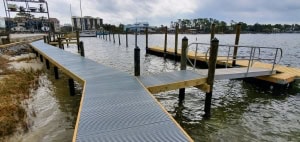
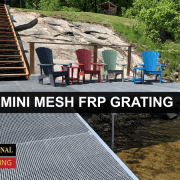
Marine decking has a hard job. It sits in the sun, gets soaked by rain, handles salt spray, and takes daily foot traffic from workers, boaters, carts, tools, and dock equipment. Wood can rot. Steel can rust. Painted surfaces can chip and become slick. That is why more marinas, dock builders, waterfront facilities, and industrial sites are considering FRP grating as a practical decking option. Fibreglass grating is light, strong, slip-resistant, and built for wet environments where corrosion is a constant concern. National Grating supplies FRP products for docks, decks, marinas, boardwalks, and other marine applications, including mini-mesh FRP grating that allows water and air to pass through while providing safe footing.
Why does marine decking need corrosion-resistant grating?
Marine decking needs to withstand wet, salty conditions. Salt water, moisture, and humidity can wear down materials fast. FRP grating will not rust like steel, so docks and marinas can spend less time on repairs, repainting, and replacements.
In marine areas, decking is almost always dealing with water. Waves splash up from below, rain collects on top, and saltwater leaves a crust behind as it dries. If the material is not designed for that kind of wear, it will break down sooner.
People often compare FRP grating and steel grating for this exact reason. Steel is strong, but it usually needs paint, galvanizing, or another coating to help stop rust. If that protective layer gets scratched, rust can begin to form. Fibreglass grating panels differ in that their corrosion resistance is inherent to the material.
For marinas, piers, floating docks, boat slips, ramps, and service platforms, that matters. Less rust means fewer sharp edges, fewer weak spots, and less time spent fixing problem areas.
How does fibreglass grating improve safety on docks?
Fibreglass grating improves dock safety by providing a more stable walking surface in wet conditions. Anti-slip fibreglass grating can help reduce slips on docks, ramps, walkways, and marine work platforms.
Wet wood can get slick. Smooth metal can be dangerous when rain, algae, fish residue, or fuel mist are present. Dock grating needs to give boots and shoes something to grip.
Many FRP grating products feature a grit surface. That added texture improves traction without requiring loose mats or temporary coatings. Mini mesh fibreglass grating can also be useful where smaller openings are preferred, such as pedestrian docks, public walkways, and areas where carts or small wheeled vehicles may pass over the surface.
Good decking does not just hold weight. It helps people move with confidence.
Why is FRP grating a good choice for busy marinas?
FRP grating is a good choice for busy marinas because it handles foot traffic, weather, and moisture without the weight and rust concerns of steel. It works well for dock grating, ramps, platforms, and access walkways.
A marina deck sees more than casual walking. It may need to support dock carts, maintenance staff, coolers, fuel equipment, hoses, storage bins, and service crews. Heavy-duty fibreglass grating can be selected for higher load needs when the span and support layout require it.
Near water, the right grating needs to do more than fit the opening. Load and span tables help you choose the proper thickness, mesh style, support spacing, and strength for the job.
How does FRP grating weight help with installation?
The FRP grating’s weight is an advantage, as fibreglass panels are typically lighter than steel grating panels. That can make shipping, lifting, cutting, and dock installation easier for contractors and maintenance teams.
A lighter deck panel can make a big difference on the job site. It is easier for crews to carry, position, and install, especially when they are working over water or around boats.
The weight of FRP grating per square meter depends on the panel style, thickness, resin, and mesh. Still, many teams choose fibreglass decking because it is easier to move than heavy steel sections. That can be useful for new builds, dock repairs, seasonal upgrades, and remote waterfront sites.
What other FRP materials can support a marine decking project?
Other FRP materials can support marine decking by adding structure, framing, handrails, and equipment support. Options may include fibreglass beams, fibreglass square tube, FRP tubing, and pultruded fibreglass structural shapes.
Some dock and platform projects need more than deck panels. They may also need corrosion resistant structural framing, fibreglass structural framing systems, FRP platform systems, or prefabricated FRP platforms. National Grating notes that, in addition to FRP floor grates, it also carries structural FRP products, including plates, decking, beams, angles, and tubes for handrail systems.
These materials can help create full marine access systems, not just walking surfaces. They are useful for platforms, catwalks, mezzanine areas, equipment frames, and waterfront maintenance zones.
Ready to choose marine decking that can handle wet conditions?
If you are planning a dock, marina, boardwalk, access platform, or waterfront repair, FRP grating is worth a close look. National Grating can help you compare molded fibreglass grating, pultruded fibreglass grating, mini-mesh fibreglass grating, heavy-duty fibreglass grating, and FRP structural shapes for your project. Contact National Grating today to request a quote and find the right marine decking for your site.
FAQ
Is FRP marine decking comfortable to walk on?
Yes. FRP marine decking can be comfortable for everyday foot traffic when the right mesh and surface are chosen. Mini mesh fibreglass grating is a good option for walking areas because the smaller openings feel steadier underfoot.
Can fibreglass grating be cut to fit around dock posts?
Yes. Fibreglass grating panels can often be cut to fit around posts, cleats, rails, pipes, and dock edges. Use the proper tools, safety gear, and sealing practices as recommended by the supplier.
Is fire-retardant fibreglass grating available?
Yes. Fire retardant fibreglass grating is available for projects where fire performance matters. Before ordering, buyers should check the resin type, required rating, and project specs.
What is the difference between molded and pultruded FRP grating?
Molded FRP grating is a good choice when you need corrosion resistance and multidirectional strength. Pultruded FRP grating is better for longer spans or heavier loads. The right option depends on the deck layout and what the grating needs to support.
https://nationalgrating.com/wp-content/uploads/2026/07/Most-Common-Industrial-Uses-for-Fibreglass-Grating-9.png6301024Chelsea Wilkinsonhttps://nationalgrating.com/wp-content/uploads/2022/01/NG-Logo-JAN-2022-300x128.pngChelsea Wilkinson2026-07-09 14:39:082026-07-09 18:03:32Why Is FRP Marine Decking a Better Fit for Wet, High-Traffic Areas?
In chemical and industrial settings, materials do not have an easy life. Floors stay wet. Equipment leaks. Washdowns happen regularly. Corrosive exposure is part of the job. That is why facility managers and project teams often move away from traditional steel and toward fibreglass grating. In the right environment, it lasts longer, needs less upkeep, and helps keep walkways and work platforms safer. National Grating supplies FRP grating and structural FRP products across North America, offering a large inventory, strong customer service, and dependable quality.
Why is steel often a problem in chemical and industrial environments?
Steel usually does not hold up as well in wet or chemical-heavy areas, which often means more repairs and more downtime. In many industrial plants, the real problem is not just wear from daily use. It is constant exposure to moisture, chemical splash, and regular washdowns. Steel grating may be fine in a dry part of the facility, but in harsher areas, rust can become a real problem. Once it starts, it can spread, weaken the grating, and turn into more maintenance than people expected. That is why a lot of buyers looking at FRPare thinking about long-term value, not just the upfront cost.
Why does fibreglass grating make more sense in these spaces?
It resists corrosion, handles moisture well, and is easier to work with during installation. This is where fibreglass grating stands out. It is built for harsh environments where corrosion is a constant issue. It is also lighter than steel, which makes it easier to move, cut, and install on-site. In a busy industrial setting, that matters. Crews do not want a flooring system that turns every repair or replacement into a major job. Corrosion-resistant grating simplifies both installation and long-term maintenance, especially in processing plants, chemical-handling areas, and outdoor industrial sites.
What type of FRP grating is best for industrial use?
The best choice depends on traffic, spans, and the aggressiveness of the environment. Molded fiberglass grating is often a strong fit for walkways and platforms because it offers good corrosion resistance and dependable grip. In areas with longer spans or loads that are mainly supported in one direction, pultruded fiberglass grating can be the better choice. In high-use areas, heavy-duty fiberglass grating may be needed to support larger loads and more demanding service conditions. The point is not to choose the most expensive option. It is to match the product to the job.
Why does slip resistance matter so much on plant walkways and platforms?
Wet surfaces, residue, and foot traffic can quickly turn a normal walkway into a hazard. Industrial safety is not only about load capacity. It is also about footing. In chemical and industrial environments, spills, mist, residue, and weather can all affect the walking surface. That is why anti-slip fiberglass grating is such a practical option. In some settings, mini-mesh fiberglass grating also makes sense because it offers a tighter surface that helps with smaller objects, heels, and added foot stability. These details matter on stair treads, elevated platforms, access ways, and service routes where people move all day.
How do resin options affect performance in chemical areas?
The resin helps determine how well the grating withstands the specific environment. Not every industrial site has the same level of exposure. A general manufacturing area may need one level of protection, while a chemical processing zone may require a higher level. That is where vinyl ester fiberglass grating often comes into the conversation. It is commonly chosen for more aggressive corrosive environments. Depending on the application, buyers may also need chemical-resistant or fire-retardant fiberglass grating. Choosing the right resin and surface type is one of the most important factors for achieving long-term performance.
Is FRP only used for floor grating?
FRP is also used for framing, platforms, and support structures throughout industrial facilities. Many buyers start by looking for industrial fiberglass floor grating, but FRP is often part of a larger system. Industrial sites may also use pultruded fibreglass structural shapes, fibreglass square tube, FRP tubing, and fibreglass beams for elevated access systems and support framing. These products can be used in FRP platform systems, fibreglass catwalk systems, and corrosion-resistant structural framing. That makes FRP useful not just for replacing old grating, but for building complete access and support structures in corrosive areas.
Why do inventory and service matter as much as the product itself?
Long lead times and poor support can slow down repairs, shutdowns, and new construction. In industrial work, delays cost money. If a plant is waiting on replacement grating or a platform system, the material supplier matters just as much as the product specs. National Grating has a wide variety of in stock inventory, excellent customer service, and high-quality products.
Chemical and industrial sites need materials that can take real abuse and still do their job safely. Fibreglass grating gives facilities a practical option for corrosive areas, wet walkways, elevated platforms, and structural systems that need to last. If you are planning a new build, retrofit, or replacement project, contact National Grating to find the right FRP grating and structural products for your site.
FAQs
Can fibreglass grating be cut to fit around pipes and equipment?
Yes. It can be fabricated to fit around existing layouts, making it useful for retrofit work and in tight industrial spaces.
Is FRP grating a good choice for outdoor industrial platforms?
Yes. It is often used outdoors because it resists corrosion and performs better in wet conditions than many traditional materials.
What is the difference between molded and pultruded grating?
Molded grating is often used for general industrial walkways and corrosive areas, while pultruded grating is commonly chosen when longer spans or directional strength are needed.
Can FRP structural products replace some steel framing in corrosive environments?
In many cases, yes. FRP structural shapes are often used where corrosion resistance, lighter weight, and lower maintenance are important.
https://nationalgrating.com/wp-content/uploads/2026/06/Molded-Fiberglass-Grating-8.png529940Chelsea Wilkinsonhttps://nationalgrating.com/wp-content/uploads/2022/01/NG-Logo-JAN-2022-300x128.pngChelsea Wilkinson2026-06-25 14:32:452026-10-16 17:46:13What Makes FRP Grating a Better Fit for Chemical and Industrial Facilities?
Data centers are full of expensive equipment, tight timelines, and zero patience for avoidable maintenance. That is why flooring and access materials matter more than they may seem at first. In these spaces, fibreglass grating and structural FRP products solve real problems. They resist corrosion, are easier to handle than heavier materials, and facilitate the creation of safe walkways and access points around cooling equipment, cables, and service areas. National Grating stocks FRP grating, beams, angles, and channels across North America and is known for outstanding customer service and quality. That can make a big difference when a job is moving fast.
Why does a grating choice matter so much in a data center?
It affects safety, maintenance, installation speed, and how easily staff can access critical equipment. In a data center, you may be dealing with raised service platforms, rooftop units, cable routes, cooling equipment, mezzanines, and narrow walkways that need to be safe and durable. FRP grating is a good fit for these areas because it resists corrosion, does not conduct electricity, and is easier to install than steel. That helps on projects where crews are working near active systems and need to keep things moving. National Grating carries molded and pultruded products for industrial and commercial use across the U.S. and Canada.
How does FRP grating compare with steel in data center environments?
FRP is lighter, corrosion-resistant, and easier to install, while steel is heavier and more likely to create maintenance issues. The data center has moisture around cooling systems, washdown zones, rooftop exposure, or chemical cleaning areas. Steel can corrode and add weight. Fibreglass grating offers a high strength-to-weight ratio, is easier to handle, and is built for corrosive environments. Fibreglass structures are “electronically transparent,” meaning they do not interfere with radio-frequency transmissions the way steel structures can. That is a useful advantage in technical facilities.
Which type of FRP grating works best in a data center?
It depends on span, load, traffic, and whether the area is a walkway, platform, trench cover, or service deck. For general walkways and access areas, molded fibreglass grating is a common choice because it offers bidirectional strength and good drainage. For longer spans or directional loading, pultruded fibreglass grating may be the better match. In higher-load areas, the heavy-duty fibreglass grating can handle more demanding service conditions, including forklift traffic in some industrial settings. This is where expertise matters. Our team can help you determine what is the best FRP grating for your project. What other FRP products help support data center builds?
Structural shapes and prefabricated framing can support platforms, catwalks, mezzanines, and equipment access systems. Modern data centers often need more than grating panels. They may also need pultruded fibreglass structural shapes, FRP structural shapes, fibreglass square tube, FRP, and fibreglass beams for support framing. These products can be used in fibreglass catwalk systems, mezzanine framing, FRP equipment support frames, and modular FRP platform systems. If you are comparing I-beam sizes and prices, small I-beam sizes, 4 I-beam, 8 I-beam, or broader structural I-beam sizes, FRP alternatives may be worth reviewing where corrosion resistance and lower weight matter more. National Grating is an FRP structural specialist and stocks beams, angles, and other FRP products through distribution centers across America.
Why do inventory and service matter so much on these projects?
Because delays on a data center job are expensive, and missed shipments can disrupt several trades at once. A data center or retrofit usually runs on a tight schedule. If grating, framing, or custom cuts arrive late, installers, electricians, mechanical crews, and site managers all feel it. National Grating has one of the broadest North American inventories, with standard FRP items stocked and ready to ship through a wide distribution network. We also have excellent customer service, competitive pricing, rush order support, and custom cutting and fabrication.
Data-centered materials that work hard without adding extra headaches. FRP grating, structural shapes, and fibreglass platforms can help reduce corrosion risk, speed installation, and improve access in demanding environments. If you are planning a new build or retrofit, contact National Grating for product guidance, custom fabrication, and fast access to one of the biggest FRP inventories in North America.
FAQs
Is fibreglass grating suitable for indoor data centers?
Yes. It is commonly used indoors for service platforms, access walkways, trench covers, and other maintenance areas where corrosion resistance and lower weight are useful.
Can FRP grating be fabricated before it ships?
Yes. National Grating says it offers custom cutting and fabrication, including CNC capability, to help products arrive ready for installation.
Does FRP grating come in standard panel sizes?
Yes. Standard sizes are commonly stocked, though exact dimensions vary by product type and load class. National Grating also offers custom sizes.
Is FRP only for grating, or can it be used for structural framing too?
It can be used for both. FRP is available in grating, Ams, angles, channels, and other structural shapes for framing systems and platforms.
https://nationalgrating.com/wp-content/uploads/2026/06/Most-Common-Industrial-Uses-for-Fibreglass-Grating-6.png6301024Chelsea Wilkinsonhttps://nationalgrating.com/wp-content/uploads/2022/01/NG-Logo-JAN-2022-300x128.pngChelsea Wilkinson2026-06-17 19:00:172026-10-16 17:46:31Why Are More Data Centers Choosing FRP Grating Over Steel?
Mini mesh FRP grating may seem like a simple panel, but choosing the right one can make a big difference. It can affect how safe the surface feels, how well it drains, how it holds up in wet or corrosive areas, and how much maintenance it needs over time.
National Grating Mini-Mesh is designed to provide a strong, waterproof decking surface that can last for years. It is strong, lightweight, easy to install and maintain, and can be a good option for projects where ADA or AODA compliance is required.
What is mini mesh FRP grating?
Mini mesh FRP grating is a molded fiberglass grating with smaller openings than standard FRP grating. The tighter grid creates a more comfortable walking surface while still letting water, air, and light pass through.
National Grating Mini-Mesh has a 3/4-inch grid pattern with 1/2-inch open squares. This gives the panel about 44% open area, allowing water and light to pass through while still providing a more comfortable walking surface.
It is often used when standard grating openings are too large for the job. You may also hear it called micro mesh or mini-grid grating.
Where is mini mesh FRP grating used?
Mini mesh FRP grating is commonly used in areas where people need a safer, more stable surface underfoot. This includes wet, outdoor, corrosive, or high-traffic areas.
Common uses include walkways, platforms, docks, decks, trench covers, stair treads, splash zones, car washes, and maintenance access areas.
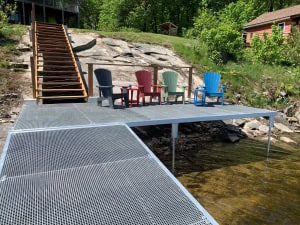
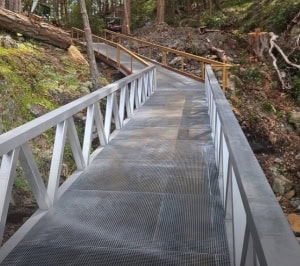
Mini mesh is especially useful for docks, marinas, decks, and waterfront areas. Saltwater does not affect FRP grating, and a built-in UV inhibitor helps protect it from sunlight. Unlike wooden docks, FRP grating will not chip, crack, or splinter in lakes and oceans. Whether the weather is hot, cold, wet, or dry, mini mesh FRP grating is built to withstand outdoor conditions.
Why choose mini mesh instead of standard FRP grating?
Mini mesh is a good choice when the walking surface matters just as much as drainage and strength. The smaller openings can make the surface easier to walk on, especially in busy areas or places where workers often move.
Because the grid is tighter, the mini mesh can feel more solid and comfortable underfoot than standard grating. It can also help reduce the chance of small tools, parts, or other items falling through the surface.
The top surface has a finely gritted, non-slip texture that provides strong traction without feeling too rough. This makes it comfortable for everyday foot traffic, including barefoot walkers, people in flip-flops, work boots, and other footwear.
Standard FRP grating is still a strong option for many industrial projects. Mini mesh is often preferred when a tighter, more foot-friendly surface is needed, such as public walkways, maintenance platforms, docks, splash zones, and access areas.
How does mini mesh FRP compare with steel or wood?
Mini mesh FRP grating is lighter than steel, corrosion-resistant, and does not need painting or galvanizing. It is also often easier to cut and install.
In areas with water, chemicals, salt, or moisture, FRP can be a practical long-term choice because it will not rust like steel. It can also be a better fit where electrical conductivity is a concern.
Compared with other materials, FRP grating can offer a longer-lasting surface with less maintenance. It will not rot, chip, crack, or splinter, making it a strong option for docks, decks, marinas, and other outdoor applications.
What should you ask before ordering?
Before ordering mini-mesh FRP grating, ask about the panel size, opening size, thickness, load rating, support spacing, resin type, grit finish, clips, cutting options, delivery time, and stock availability.
These questions can help ensure you get the right grating for the job, rather than ordering a panel that does not match the application.
Ready to choose the right mini mesh FRP grating?
National Grating can help you compare options and find the right mini mesh FRP grating for your project. Contact National Grating to review your application and request pricing.
FAQs
What is mini mesh FRP grating used for?
Mini mesh FRP grating is commonly used for walkways, platforms, docks, decks, trench covers, stair treads, splash zones, and maintenance access areas where a safer, more stable walking surface is needed.
Why choose mini mesh instead of standard FRP grating?
Mini mesh has smaller openings, which can make it more comfortable to walk on and help reduce the chance of small tools or items falling through. It is often used when a tighter, more foot-friendly surface is needed.
Is mini mesh FRP grating slip-resistant?
Many mini-mesh FRP grating panels are available with a gritted surface to improve traction, especially in wet, outdoor, washdown, or industrial areas.
Can a mini mesh FRP grating be cut to fit a project?
Yes. Mini mesh FRP grating can often be cut to fit specific areas or layouts. For best results, ask your supplier about cutting options and whether cut edges need to be sealed.
https://nationalgrating.com/wp-content/uploads/2026/05/Most-Common-Industrial-Uses-for-Fibreglass-Grating-7.png6301024Chelsea Wilkinsonhttps://nationalgrating.com/wp-content/uploads/2022/01/NG-Logo-JAN-2022-300x128.pngChelsea Wilkinson2026-05-27 14:43:462026-10-16 17:46:51What Should You Know Before Buying Mini Mesh FRP Grating?